
Complete Guide to Buying Dairy Processing Equipment
- What Is Dairy Processing Equipment?
- Why Getting This Right Actually Matters
- Equipment Categories
- What to Verify Before Ordering
- Equipment Overview
- What Quality Equipment Delivers
- Where This Equipment Gets Used
- Picking the Right Supplier
- About MEI
- Conclusion
For dairy farmers, cooperative buyers, and plant managers who want straight answers — on what to buy, what to check, and what to watch out for.
Most dairy equipment purchases go wrong at the start — not the end. Someone picks a machine based on the sticker price, skips the capacity check, and then wonders three months later why their Milk Processing Equipment is creating spoilage problems that didn't show up in the brochure.
It doesn't have to go that way. One Bulk Milk Cooler, properly sized and maintained, can run cleanly for a decade. This guide covers the decisions that actually separate a good purchase from a costly one.
What Is Dairy Processing Equipment?
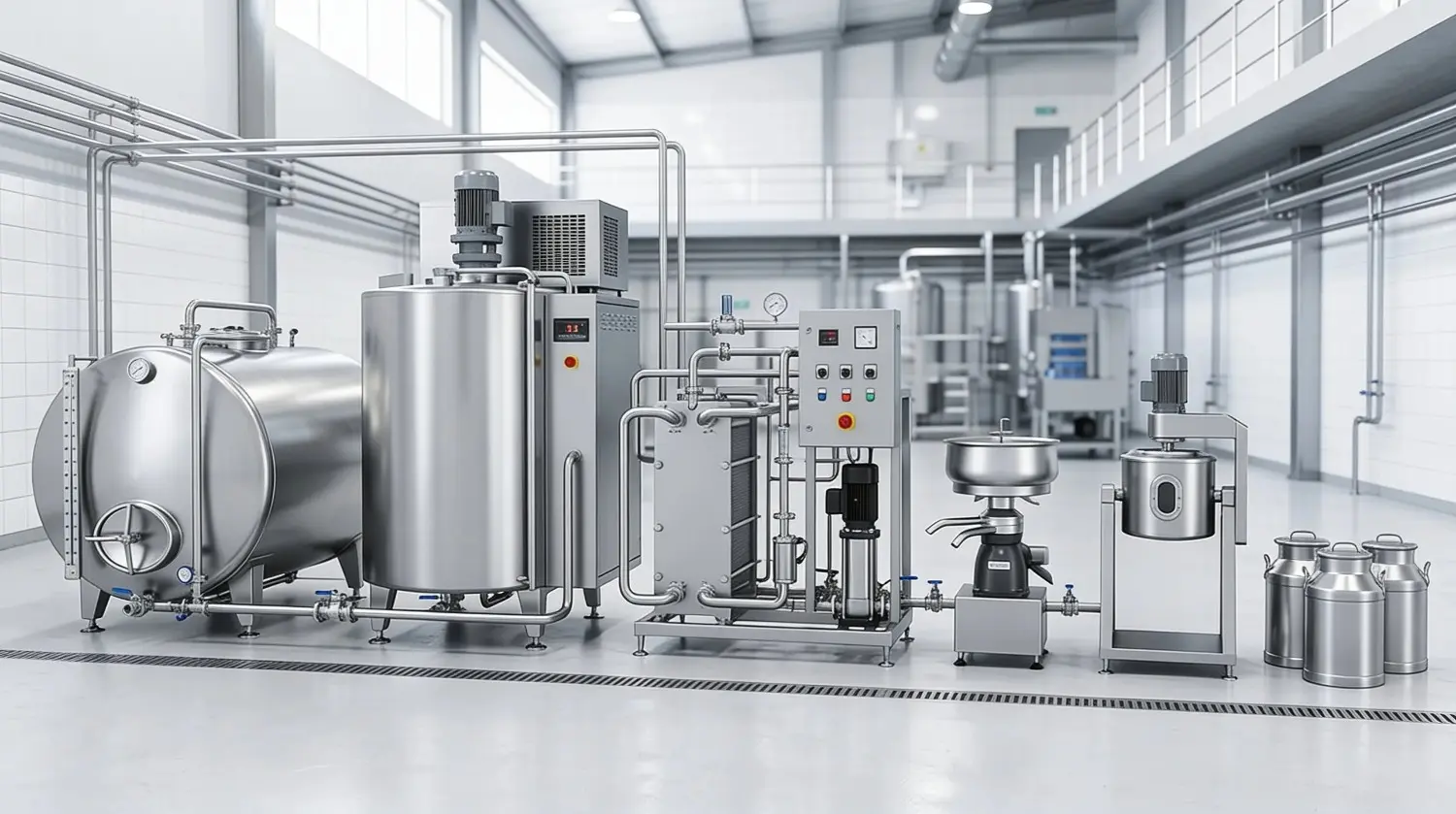
Every machine between the animal and the packaged product. Dairy Processing Machinery cools, heats, separates, churns, presses, and stores milk. Each stage feeds the next — take one out and the whole sequence stalls.
Dairy Plant Equipment at a full-scale facility includes pasteurisers, cream separators, butter churners, cheese vats, cooling tanks, storage vessels, and milking assemblies. Smaller units run a version of that list depending on output — fluid milk, ghee, paneer, butter, or a mix.
Why Getting This Right Actually Matters
Milk is unforgiving. At room temperature it deteriorates within two hours of collection. Weak Dairy Farm Equipment choices — undersized, wrong spec, poor weld finish — translate into spoiled batches and failed audits. Not occasionally. Consistently.
Get the spec right and you get:
- Stable output quality with no batch-to-batch variation
- Longer shelf life from controlled heat treatment and rapid cooling
- Less manual work — CIP systems handle what previously took hours
- FSSAI-aligned hygiene built into the machine from day one
- Lower energy costs from modern motors and compressor designs
Equipment Categories
Here are some Equipment Categories.
Cooling and Storage
First job after collection. A Bulk Milk Cooler drops raw milk temperature fast — the single most effective protection you have before processing begins. Milk cooling tanks and chillers fall here too. What you choose depends on daily intake volume and the time gap before processing.
Pasteurisation
Non-negotiable for any dairy selling to consumers. The Milk Pasteurizer applies controlled heat for a fixed duration — enough to eliminate pathogens without damaging the milk. Batch units suit lower volumes; continuous-flow models handle higher throughput. Internal surfaces should be SS 304 or 316.
Separation and Churning
Cream separators pull fat from whole milk for butter and ghee production. Butter churners convert that fat into finished product. You'll find wooden artisan designs and full stainless commercial versions — the choice depends on your scale and brand positioning.
Cheese and Curd
Cheese vat machines and press equipment handle curd cutting, draining, and shaping. If paneer or hard cheese is on your product list, this equipment is not optional.
Milk Cans
Aluminium and SS cans still move raw milk from farm to processor. Stainless holds up better under repeated sanitisation. Aluminium is lighter for manual-handling environments.
What to Verify Before Ordering
Before any Dairy Machinery order is confirmed, check these:
- Steel grade: SS 304 minimum on milk-contact surfaces; SS 316 where acidic by-products are involved
- Weld finish: Smooth, passivated internal welds — rough beads trap residue and cause contamination
- CIP compatibility: Clean-in-place systems save hours of manual cleaning weekly, compounding over years
- Capacity sizing: Spec to peak-day volumes — that's the number that creates problems, not your daily average
- Certifications: ISO, CE, FSSAI-aligned — get documentation before the purchase, not after
- Spare parts: Lead time on critical components. Ask specifically before ordering
- Controls: Digital temperature and timer controls remove human error from your most sensitive process points
Equipment Overview
| Equipment | What It Does | Who Needs It | Material |
|---|---|---|---|
| Bulk Milk Cooler | Rapid post-collection cooling | Farms, collection centres | Stainless steel |
| Milk Pasteurizer | Pathogen removal via heat | All processing dairies | SS 304 / SS 316 |
| Cream Separator | Fat extraction from milk | Butter and ghee producers | Stainless steel |
| Butter Churner | Converts cream to butter | Artisan and commercial | Wood / SS |
| Cheese Press / Vat | Curd pressing and shaping | Paneer and cheese plants | Stainless steel |
| Milking Machine | Automated milk extraction | Dairy farms | SS / food-grade rubber |
| Milk Storage Tank | Holds processed milk | Processing plants | SS 304 |
What Quality Equipment Delivers
Buying good Dairy Processing Equipment from a credible source pays back well past the initial cost:
- Longer machine life — fewer replacements, less unplanned capital spend
- Cleaner audit results — smooth SS surfaces are genuinely easier to sanitise
- Export access — certified equipment opens doors to buyers with strict spec requirements
- Custom fit — OEM fabrication means machines built to your floor plan
- Dependable peak-season performance with real after-sales backing
Where This Equipment Gets Used
Dairy Plant Equipment works at every point in the supply chain:
- On-farm: Milking machines and bulk coolers for the post-collection stage
- Collection centres: Cooling tanks and milk cans before dispatch to processors
- Processing plants: Pasteurisers, separators, churners, and storage tanks
- Specialty producers: Vats and presses for paneer, cheddar, and artisan cheese
- Export dairies: dairy processing machinery that meets international hygiene and documentation requirements
|
FACT: SS 316 contains molybdenum — that's what makes it more resistant to whey and acidic by-products than SS 304. Worth specifying for cheese lines and fermented product operations. |
Picking the Right Supplier
When you're ready to Buy Dairy Processing Equipment, the supplier decision carries as much weight as the machine choice. Sort these out before any order is placed:
- Real fabrication: A genuine Dairy Equipment Manufacturer has in-house production. Not a catalogue and a forwarding address
- Export history: A proven Dairy Equipment Exporter has cleared tougher compliance requirements than most domestic buyers ever ask for
- Product range: Single-source Dairy Equipment Suppliers remove compatibility risk across a multi-machine line
- Post-sale terms: Installation, operator training, and spare part access — in writing, before the order
- Working references: Speak with existing clients at a similar scale. If that request meets hesitation, factor it in
About MEI
MEI Medical is a well-known and reputable company in the dairy equipment business, having a history of providing quality, durable, and efficient equipment. We have the experience of 25+ years producing various types of dairy equipment with high-grade stainless steel to offer hygiene, reliability, and durability. We aim to assist dairy companies in providing equipment that is up to industry standards and that will assist the companies to expand and succeed. Under the direction of Mr. Pramod Pal the platform offers high-quality dairy equipment to a large number of businesses. We also offer cream separators, butter churners, milk cans, SS milk cans, and other dairy equipment. Our services offer the solutions to improve productivity and operational efficiency. MEI Medical is committed to providing quality, innovation, and customer satisfaction.
Conclusion
There's no shortcut on Dairy Processing Machinery decisions. The machines running in your plant today are the ones shaping output, compliance, and operating costs for the next decade. Rushed purchasing decisions show up fast — spoiled product, audit failures, early replacements. A Dairy Equipment Manufacturer with genuine fabrication capability and honest after-sales support is simply worth more than a cheap quote from an unknown name.
The Best Dairy Processing Equipment isn't always the most expensive. It's what runs reliably under pressure, clears every inspection, and still has proper support three years later. Buy to that standard.
| Looking to build or upgrade your dairy line? Explore our full range of Dairy Farm Equipment and find the right fit for your operation. Contact us today for expert guidance and product recommendations. |